
Low-E glass is window glass with a microscopically thin metal or metal oxide coating that reflects heat while letting visible light through. It keeps heat inside in winter and outside in summer. The U.S. Department of Energy says low-E windows typically cost 10% to 15% more than regular windows but can cut energy loss through the window by as much as 30% to 50%. Most low-E coatings sit sealed between the panes, but some face the room, and those need gentle cleaning with no blades or scrapers.
Window makers explain the science well, but few explain how to pick the right low-E for your climate, what the downsides are, or how to clean it. This guide covers all three.
How the Coating Works
“Low-E” stands for low emissivity, which is how much heat a surface gives off. Glass maker Vitro lists clear glass at an emissivity of about 0.84 and high-performance low-E coatings as low as about 0.02 (Vitro explainer). The lower the number, the more heat the glass reflects instead of passing it along.
The DOE describes the coating as “a microscopically thin, virtually invisible, metal or metallic oxide layer” on one or more panes of glass (DOE Energy Saver window types). It lets most daylight through but reflects heat: Because the coating contains metal, it can also weaken some radio signals, which is one reason a grill thermometer may lose its connection once you step inside. Our guide to the best wireless meat thermometer covers models built to handle that.
- In winter, it bounces heat from your furnace back into the room.
- In summer, it reflects part of the sun’s heat before it gets inside.
Hard-Coat vs Soft-Coat Low-E
| Hard-coat (pyrolytic) | Soft-coat (sputtered) | |
|---|---|---|
| How it’s made | Baked onto the glass while it is being made | Applied in a vacuum chamber afterward |
| Durability | Very tough; can face the room or outdoors | Delicate; sealed inside a double-pane unit |
| Performance | Good | Higher, with lower emissivity |
| Common use | Storm windows, room-side coatings | Most modern double-pane windows |
Guardian Glass and Vitro both describe soft coats as the higher-performance option, built from multiple thin layers that usually include silver (Guardian Glass low-E overview).
Where the Coating Goes
Glass makers number the surfaces of a double-pane window from outside in: surface 1 faces outdoors, surfaces 2 and 3 face the sealed gap, and surface 4 faces your room.
- Surface 2: Common in warm climates to reflect the sun’s heat before it gets in, according to Guardian Glass.
- Surface 3: Common in cold climates to hold indoor heat, Guardian notes.
- Surface 4: A durable room-side coating added for extra insulation. Pilkington says adding one to a unit that already has a surface 2 coating improves the U-factor by about 20% (Pilkington surface 4 bulletin).
Surfaces 2 and 3 are sealed away and never need cleaning. Surface 4 is the one you can touch, and it needs care.
How to Read the Window Label
Every rated window carries an NFRC label. These are the numbers that matter:
| Rating | What it means | What you want |
|---|---|---|
| U-factor | How much heat escapes | Lower is better |
| SHGC (solar heat gain) | How much of the sun’s heat gets in | Low in hot climates, higher in cold ones |
| VT (visible transmittance) | How much daylight gets in | Higher means brighter rooms |
Guardian and Vitro add one more number: the light-to-solar-gain ratio, which is VT divided by SHGC. A ratio of 1.25 or higher marks glass as “spectrally selective,” meaning it lets in light while keeping out heat.
Choosing Low-E for Your Climate
ENERGY STAR Version 7.0 sets limits by climate zone, as summarized by Cardinal Glass (Cardinal Glass: ENERGY STAR 7.0):
| ENERGY STAR zone | U-factor | SHGC |
|---|---|---|
| Northern | 0.22 or lower | 0.17 or higher |
| North-Central | 0.25 or lower | 0.40 or lower |
| South-Central | 0.28 or lower | 0.23 or lower |
| Southern | 0.32 or lower | 0.23 or lower |
In cold zones, a higher SHGC lets winter sun warm the house. In hot zones, a low SHGC keeps the sun’s heat out. Check ENERGY STAR’s map for your county’s zone. For a closer look at window styles, see our guide to the types of windows. If you would rather add film than replace the glass, our guide to house window tint compares film types and costs. A ceiling fan helps either way, and our guide on how to install a ceiling fan covers sizing and setup.
Pros and Cons of Low-E Glass
| Pros | Cons |
|---|---|
| Cuts energy loss by up to 30% to 50% (DOE) | Costs about 10% to 15% more (DOE) |
| Rooms feel less drafty near the glass | Slight tint and a bit less daylight with some coatings |
| Most coatings reduce UV fading (Vitro) | Dew can form on the outside of the glass on cool mornings |
| Helps meet ENERGY STAR limits | Reflected sun can damage nearby vinyl siding |
Condensation on the outside
Andersen explains that the coating slows heat flow so well that the outer pane can stay a few degrees cooler, so dew can form on the outside on cool, humid mornings. It says this shows the glass is working and usually evaporates during the day (Andersen help center).

Melted siding next door
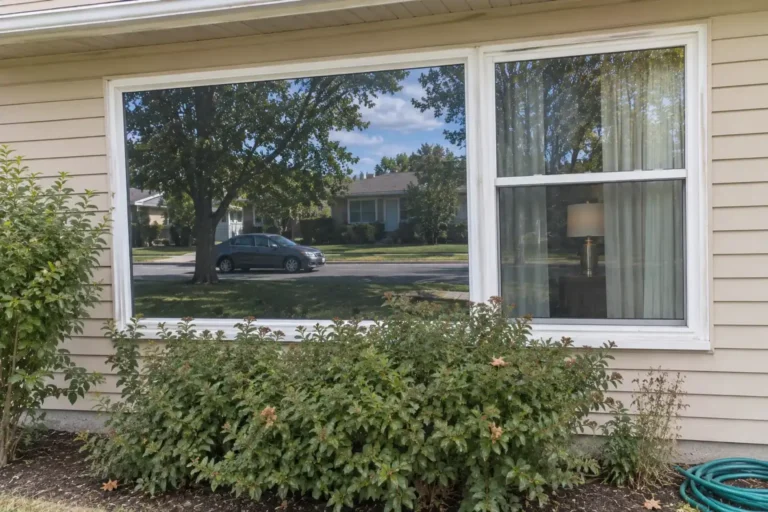
A Massachusetts building advisory, reprinting a National Association of Home Builders report, says sunlight reflected from double-pane windows, especially low-E ones, can heat and warp vinyl siding on nearby houses. Vinyl starts to soften around 160°F to 165°F, and reflected heat has been measured above 200°F (Massachusetts vinyl siding advisory). The report suggests screens, awnings, or plants to break up the reflection.
How to Clean Low-E Glass
Most low-E coatings are sealed inside the window, so you clean those windows like any other glass. Our guide on the best way to clean windows covers the squeegee method.
Room-side (surface 4) coatings and coated storm doors are different, because the coating is exposed:
- No blades or metal. Pilkington says not to use razor blades, steel wool, or other metal objects on a coated surface. Metal can leave marks that look like scratches.
- No harsh scrubbing. Pilkington warns that aggressive abrasives can rub a permanent bright spot into the coating.
- No scrapers or squeegees. Larson’s care sheet for its low-E storm door glass says never to use any scraper, plastic or metal, on the coated surface, and does not recommend rubber squeegees (Larson low-E cleaning sheet).
- Gentle cleaners. Larson suggests plain water first, then 10% to 20% vinegar in water, or a glass cleaner. It says to avoid cleaners high in alcohol or ammonia.
Safety note: If your windows have a room-side coating, tell your window cleaner before they start. Pros often use razor scrapers on bare glass, and one pass on a coated surface can leave a permanent mark. Check your window paperwork or ask the maker if you are not sure which surface is coated.
Frequently Asked Questions
Is low-E glass worth it?
For most homes, yes. The DOE says low-E windows cost about 10% to 15% more but can reduce energy loss by 30% to 50%, and Infinity Windows notes that most premium windows now include low-E to meet ENERGY STAR Version 7.0. The payback depends on your climate, energy prices, and how many windows you have.
Does low-E block UV rays?
Most low-E coatings reduce UV, which helps slow fading of floors and furniture, according to Vitro. It is not a full UV block, so check the window’s specs if fading is a big concern.
Can you add low-E to existing windows?
You can’t add a factory coating to installed glass, but the DOE notes that do-it-yourself low-E films are available. Check the film maker’s glass chart first, since some films can stress double-pane glass. Our guide to privacy film for windows explains what to check before applying any film.
How can I tell if my windows have a low-E coating?
Look for the NFRC label or the window maker’s paperwork, which list the coating and ratings. You can also hold a light near the glass at night and look at the reflections. A reflection with a slightly different color often means a coated pane.
The Bottom Line
Low-E glass is one of the simplest ways to make windows more energy efficient. Choose the U-factor and SHGC that fit your climate zone, expect a small price bump and a slight tint, and don’t worry about dew on the outside on cool mornings. If any coating faces your room, clean it gently and keep blades away from it. If you live in Central Oregon, our residential window cleaning team knows how to clean coated glass without damaging it.


4 Comments
Comments are closed.