
Window well covers sit over the pit outside a basement window to keep out rain, snow, leaves, pests, and falls, while still letting light in. The main types are bubble covers, flat covers, sloped polycarbonate covers, and steel grates. If the window is an emergency exit, the cover must open from inside without a key, tool, or special knowledge. Measure the well’s width and how far it sticks out from the house before you buy, and clean clear plastic covers with soap and water, never a squeegee or blade.
Most pages that rank for this are product catalogs. They list sizes and prices but rarely explain egress rules, load ratings, or care. This guide covers all of that, including how to keep a clear cover clear.
Why Cover a Window Well?
- Water and snow. An open well collects rain, snowmelt, and leaves. If the drain at the bottom clogs, water can pool against the window. Sending roof runoff into a rain barrel or cistern can help, and our guide to what is a cistern explains how.
- Falls. Lowe’s notes that children and pets can fall into uncovered wells, and that wells hidden under snow are a hazard too (Lowe’s installation guide).
- Pests and debris. Covers keep out animals, trash, and leaves that rot in the well.
- Light. Clear covers protect the well while still letting daylight into the basement.
Types of Window Well Covers
| Type | Material | Light | Strength | Best for |
|---|---|---|---|---|
| Bubble (dome) | Plastic, polyethylene or acrylic | Good | Light to medium | Standard round wells, rain and leaves |
| Flat | Plastic or polycarbonate | Good | Medium | Low-profile look, wells near walkways |
| Sloped custom | Polycarbonate on an aluminum frame | Very good | High | Egress wells, snowy climates, odd sizes |
| Steel grate | Steel bars or mesh | Good | High | Fall protection, not water |
| Grate plus clear top | Steel with a polycarbonate panel | Good | High | Fall protection and weather protection |
Bubble covers are the cheapest and most common. Flat and sloped polycarbonate covers are stronger, and sloped tops shed water and snow better. Steel grates stop falls but let rain, snow, and leaves straight through unless they have a clear panel on top.
What they cost
On store and maker pages we checked in November 2026, The Home Depot listed covers from about $11 for a basic round plastic cover to about $692 for a large polycarbonate cover. Custom sloped polycarbonate covers started around $188 to $298 at Window Well Supply and The Home Depot. Lustercraft’s heavy-duty covers ran $512 to $996.
Egress Window Wells: The Rules That Matter
Safety note: If the basement window is an emergency escape opening, such as a basement bedroom window, the cover must not trap anyone inside. Under the International Residential Code, as summarized by Washoe County, Nevada, any cover or grate over an escape opening must be removable from the inside without a key, tool, special knowledge, or more force than it takes to open the window itself (Washoe County egress handout). Never lock or screw down a cover over an egress well.
The same code sets the size of the well:
- At least 9 square feet of floor area, with no side shorter than 36 inches.
- A permanent ladder or steps if the well is more than 44 inches deep.
- Ladder rungs at least 12 inches wide, sticking out at least 3 inches from the wall, and no more than 18 inches apart.
Codes vary by state and city, so check with your local building department before you install or change a cover on an egress well. Lowe’s also notes that egress wells use a different clip layout, with clips on the sides only, so the cover can lift out of the way.
Load Ratings: What to Look For
Sellers make very different weight claims, and most don’t say how they were tested:
| Seller | Claim |
|---|---|
| Lowe’s guide | Suggests a cover rated over 100 pounds if small children are around |
| Guardian Covers | 125 pounds for its entry line; up to 500 pounds plus 1,250 pounds of snow for its top line |
| WindowWellCovers.com | “Supports up to 400 pounds,” with no load type stated |
If falls or heavy snow are a concern, choose a cover with a stated weight rating and ask the seller how it was tested. Don’t let anyone stand or walk on a cover unless the maker says it is rated for that.
How to Measure for a Window Well Cover
These steps follow the Lowe’s installation guide:
- Measure the width of the well at the front and at the back where it meets the house. Use the widest number.
- Measure the projection, from the house wall to the outside edge of the well, in at least two places.
- Note the shape: rounded, square, or U-shaped.
- Check the back edge. Some covers need to tuck under siding or against the foundation.
For an odd shape or a large egress well, a custom cover is usually the better fit. If the basement window doesn’t need to be an exit, our glass block window guide covers a sealed, private option.
How to Install a Cover
- Center the cover on the well with the back edge snug against the house.
- Mark the clip spots. Lowe’s suggests marks about 4 to 6 inches from the house on each side. Egress wells get side clips only.
- Drill carefully. Put a scrap 2×4 under the plastic and use a sharp bit. Lowe’s warns that worn bits can crack plastic.
- Attach the clips so they grip the well edge firmly.
- Test the fit. Check that the cover doesn’t buckle and, on egress wells, that it lifts off easily from inside.
How to Clean Covers and Window Wells
Clear covers are usually polycarbonate, which scratches far more easily than glass. Cleaning habits that work on glass, like a squeegee or a scraper, can ruin them.
Palram, a large polycarbonate maker, gives these care rules (Palram polycarbonate care guide):
- Wash with lukewarm water and mild dish soap, using a soft sponge or 100% cotton cloth.
- Rinse right away with clean, cold water.
- Dry with a soft cotton cloth to reduce water spots.
- Never use abrasive or high-alkaline cleaners.
- Never use squeegees, razors, or sharp tools on polycarbonate.
- Don’t wipe it dry and dusty, since trapped grit scratches the surface. Rinse loose dirt off first.
- Avoid cleaning in direct sun, and don’t leave cleaners sitting on the surface.
Then clean the well itself. Lift the cover, scoop out leaves and debris, and check that the drain at the bottom is clear. Do it in late fall, after the leaves drop, and again after the snow melts. A clear well with a working drain matters more for keeping water out than the cover does. If you are planting fall mums near the house, our guide to the November birth flower explains how to keep them alive through winter. Overflowing gutters often dump water right into window wells, and our guide to the parts of a roof shows how the roof edge should carry water away.
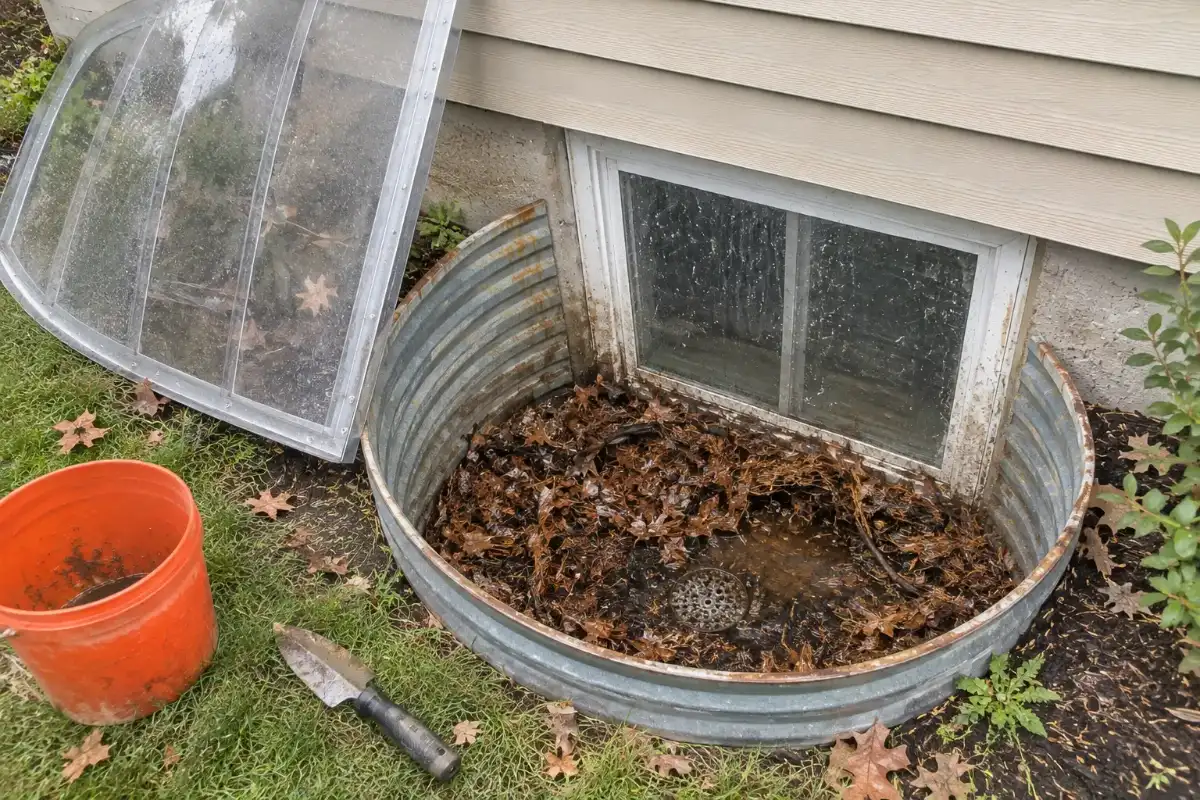
For the basement window inside the well, our guide on the best way to clean windows covers glass, frames, and sills, and our window track cleaning guide shows how to clear the drain slots on sliding windows.
Frequently Asked Questions
Do window well covers need to open from the inside?
Yes, if the window is an emergency exit. The International Residential Code requires covers over escape openings to be removable from inside without a key, tool, special knowledge, or extra force. Check your local building code for the exact rules where you live.
Can you walk on a well cover?
Only if the maker rates it for that. Many basic bubble covers aren’t built to hold a person. Look for a stated weight rating, and keep children and pets off covers that don’t have one.
Do window well covers stop water from getting in?
They help a lot by keeping rain, snow, and leaves out of the well. But water can still get in from the soil around the well, so the drain at the bottom needs to stay clear. If water keeps pooling, the drainage needs repair, not just a cover.
How do I clean a cloudy plastic well cover?
Rinse off loose dirt, wash with lukewarm water and mild dish soap, rinse with cold water, and dry with a soft cotton cloth. Don’t use abrasive cleaners, squeegees, or blades. If it is still cloudy after washing, the surface may be scratched or weathered, and cleaning won’t fix that.
The Bottom Line
Pick the cover by what you need most: a bubble cover for basic rain and leaf protection, a sloped polycarbonate cover for snow and egress wells, or a steel grate when falls are the main worry. Keep egress covers removable from inside, measure width and projection before you buy, and clean clear covers gently with soap and water. If you live in Central Oregon, our residential window cleaning team can clean basement windows and covers without scratching them.

2 Comments
Comments are closed.