
A magnetic window cleaner works, but only on the right glass. It uses two pads held together by magnets, so moving the inside half drags the outside half across the glass. It does a good job on fixed windows you can’t reach from outside, as long as the magnet strength matches your glass thickness. It won’t clean the edges and corners well, it won’t remove hard water spots, and it won’t give you the streak-free finish of a squeegee.
Most reviews online are either a store selling them or a cleaning company telling you not to buy one. This guide sits in the middle. It shows you when the tool is worth it, how to pick one that fits your windows, and how to use it without scratching the glass or dropping half of it off the second floor.
What It Does Well, and Where It Falls Short
| Good at | Not good at |
|---|---|
| Fixed windows that don’t open | Edges and corners of the glass |
| Upper windows you can reach from inside | Hard water spots and mineral crust |
| Light dust, pollen, and rain spots | Heavy grime, sap, and smoke film |
| Big panes with no grids | Windows with grids or divided lites |
| Quick touch-ups between full cleanings | A perfect, streak-free finish |
Think of it as a maintenance tool, not a deep cleaning tool. A robot vacuum plays the same role for floors, and our guide to lab-tested robot vacuums compares the top models. If the outside glass is caked with dirt, the pad pushes grime around and can drag grit across the surface.
Glass Thickness Decides Everything
The two halves only stay together if the magnets are strong enough for your glass. Too weak and the outside half falls off. Too strong and the tool is hard to move and presses grit into the glass.
A double-pane window is two panes of glass plus the air gap between them. BRANZ, New Zealand’s building research group, lists common pane thicknesses of 4 to 8 mm and air gaps of 6 to 16 mm (BRANZ: What is double glazing?). That means a double-pane unit can be anywhere from about 14 mm to over 30 mm thick.
Tools are sold for different ranges. Here is what we saw on store listings in November 2026:
| Your glass | What to look for on the box |
|---|---|
| Single pane (one layer) | About 3 to 8 mm |
| Thin double pane | About 8 to 15 mm |
| Standard or thick double pane | About 18 to 30 mm, or an adjustable model |
| Triple pane | Most tools won’t reach; check for a high-end adjustable model |
Retail listings ranged from about $10 to $47 at Walmart, with most between $15 and $25. Professional-grade adjustable models from Tyroler, the maker of The Glider, listed at about $130 to $170 and come in versions rated up to 0.7, 1.1, or 1.6 inches.
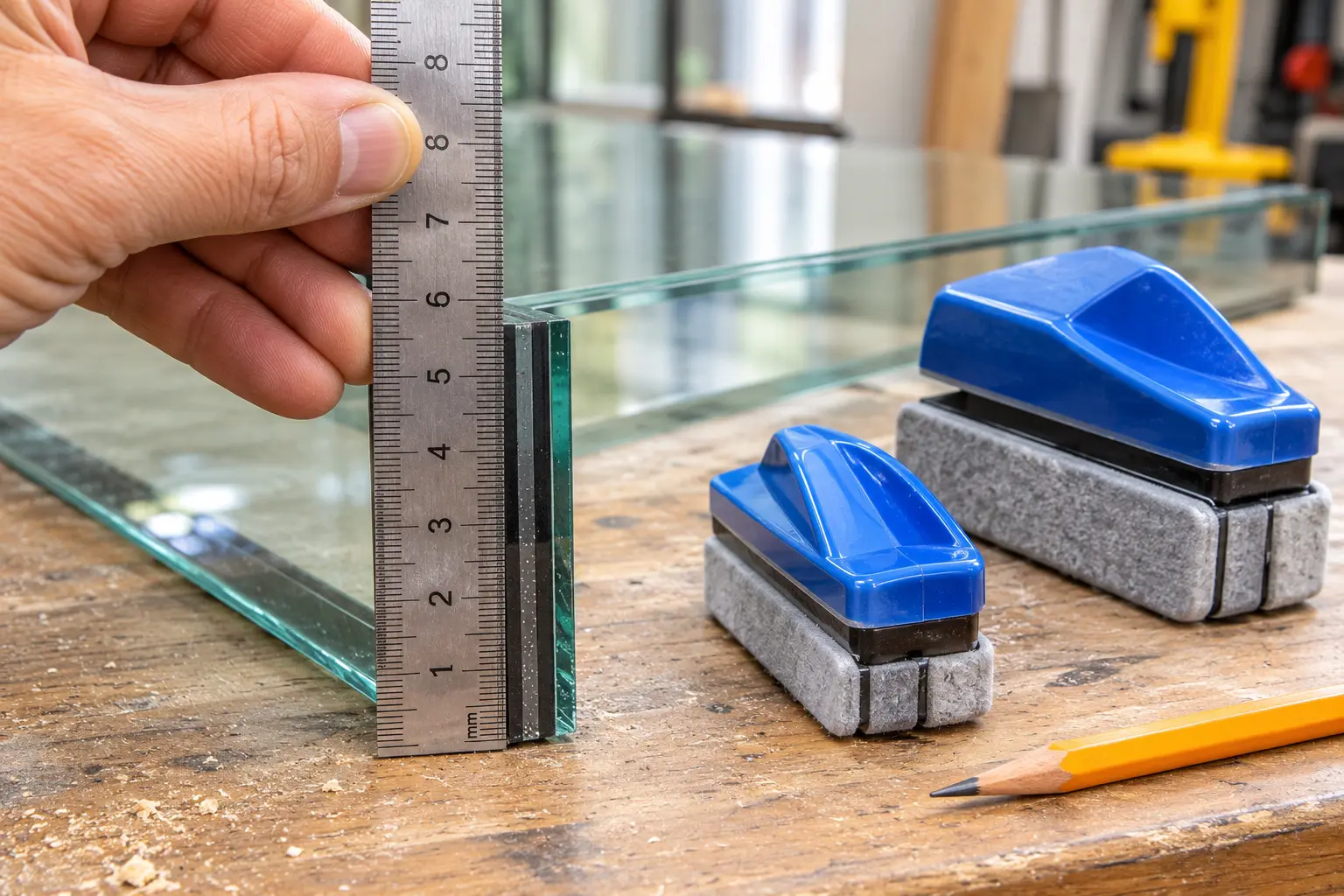
How to find your glass thickness
- Check your paperwork. Window invoices and some labels list the glass unit size.
- Ask the window maker. Most can look up the glass from the model or serial number.
- Use a glass thickness gauge. These read the thickness from one side. Some higher-end kits include one.
- Buy adjustable. If you can’t measure, an adjustable model gives you room for error.
How to Use a Magnetic Window Cleaner
1. Wash off loose grit first
If the outside glass is very dirty, rinse it with a hose before you start. Loose grit under the pad is how glass gets scratched.
2. Remove the screen
Most windows have a screen on the outside. The outer pad can’t work through it, so take it off first.
3. Wet the pads
Mix about a teaspoon of dish soap into two cups of water. Soak both pads and squeeze out the extra so they are damp, not dripping.
4. Attach the safety cord
Clip the tether to the outside half and hold the other end in your hand or loop it around your wrist. If the magnets separate, the cord keeps the outer half from falling.
5. Line up the two halves
Hold the outside half against the glass, then bring the inside half to meet it. Keep your fingers clear, since strong magnets snap together hard.
6. Clean in a set pattern
Move slowly. Start in a bottom corner, go up the side, across the top, and down the other side. Then work across the glass in overlapping strips from top to bottom. Lead with the pad and let the squeegee edge follow. Turn gently, since fast turns are when the halves separate.
7. Rinse the pads often
Pads fill with dirt quickly. Rinse them every window or two, or the dirt goes back onto the glass.
8. Finish the edges by hand
Wipe the inside corners with a microfiber cloth. For the outside edges, you will need a pole or a later visit.
Safety: Read Before You Buy
Safety note: Always use the tether on upper floors. A falling outer half can hit someone below or break on a patio. Never lean out a window or stand on a ladder to place the outside half.
- Pinched fingers. Strong magnets snap together fast. Some models, such as one adjustable model sold at Lowe’s, reset to the weakest setting when removed from the glass to help prevent finger injuries.
- Pacemakers and heart devices. Medtronic advises keeping any item with a magnet at least 6 inches (15 cm) away from a heart device (Medtronic heart device answers). If you have one, let someone else handle the tool.
- Coated glass. Some energy-efficient windows have a coating on the room-side glass. Window maker Milgard warns against abrasive pads on this type of glass (Milgard care and maintenance). Keep the pads clean and soft, and replace them when they wear out.
Magnetic Cleaner vs Other Options
| Method | Best for | Downside |
|---|---|---|
| Magnetic cleaner | Fixed windows, quick touch-ups | Weak on edges, spots, heavy dirt |
| Squeegee on an extension pole | Ground floor and some second floor glass | Takes practice; outside only |
| Tilt-in sash | Windows that tilt in for cleaning | Only on certain window styles |
| Professional water-fed pole | Upper glass, full exterior clean | Costs money |
If your windows tilt in, you don’t need a magnetic tool at all. Tilt the sash and clean both sides from inside. For a step-by-step squeegee method, see our guide on the best way to clean windows.
Dirt a Magnetic Pad Can’t Handle
Some kinds of dirt need more than a soft pad sliding across the glass:
- Sprinkler and hard water spots. White mineral spots from sprinkler or well water bond to the glass. A soft pad slides right over them. They need a proper hard water stain removal treatment.
- Smoke and pollution film. Smoke from wildfires, fireplaces, or busy roads leaves an oily film that smears unless it is washed with enough soap and rinsed off.
- Tree pollen and sap. The sticky film that builds up in spring, especially on glass near trees, often needs more scrubbing than a magnet pad can give.
A magnetic cleaner is a good tool for keeping clean glass clean between washes. It is not a replacement for a full exterior wash.
When to Call a Pro
If you have second-story glass that doesn’t tilt in, hard water spots, or a big wall of windows, a full professional clean gets you further. If you live in Central Oregon, our residential window cleaning service uses water-fed poles that reach about 40 feet from the ground, so nobody climbs onto your roof.
Frequently Asked Questions
Do magnetic window cleaners work on double-pane windows?
Yes, if you buy one rated for your glass thickness. Double-pane units vary a lot, from about 14 mm to over 30 mm. A model sold for single-pane glass will fall off a thick double-pane window. Measure first, or buy an adjustable model.
Can a magnetic cleaner scratch glass?
It can if grit gets trapped under the pad or the magnets are too strong for your glass. Rinse loose dirt off the glass first, keep the pads clean, and don’t use a model that is far too strong for your window.
Do they work on triple-pane windows?
Most don’t. Triple-pane glass is usually too thick for standard tools. A few high-end adjustable models are rated for thicker glass, so check the rating against your window before you buy.
Is a magnetic window cleaner worth buying?
It is worth it if you have fixed windows you can’t reach from outside and the glass is only lightly dirty. It is not worth it for tilt-in windows, windows with grids, or glass with hard water spots.
The Bottom Line
A magnetic window cleaner is a handy touch-up tool, not a deep cleaner. Match the magnet strength to your glass thickness, rinse off grit first, use the safety cord, and move slowly. Expect good results in the middle of the glass and weaker results at the edges. For hard water spots, smoke film, or a full outside clean, use a squeegee or call a pro.


One Comment
Comments are closed.