
To measure for curtains, decide where the rod will go first, then measure from it. Hang the rod about 4 to 10 inches above the window frame, or higher if you have room, and let it extend about 8 to 10 inches past the frame on each side. Measure the full rod width, not just the glass, and buy panels that add up to about 2 to 3 times that width so they look full when closed. For length, measure from the rod (or the bottom of the rings) down to where you want the curtains to end: the sill, just above the floor, or a puddle on the floor.
Most guides on how to measure for curtains give a few numbers and move on, and they often disagree. This guide explains each measurement, shows a worked example, and covers the small details, like rings and floor gaps, that cause most curtain mistakes.
What You’ll Need
- A steel tape measure, not a cloth one
- A pencil and paper, or your phone’s notes app
- A step stool or ladder
- A level, if you’re marking bracket spots
Measure every window separately, even ones that look the same, and write width first, then length.
Step 1: Decide Where the Rod Goes
Everything else depends on the rod position, so set this first.
Height
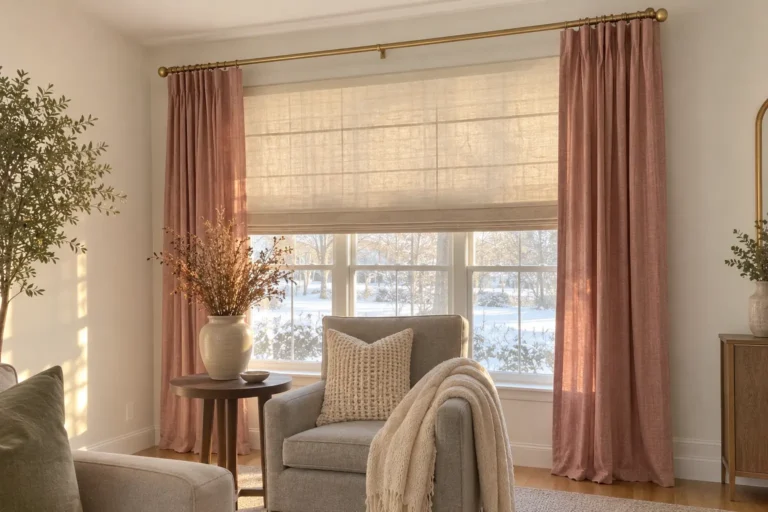
Home Depot suggests placing the rod anywhere from a few inches above the window trim to a few inches below the ceiling (Home Depot curtain measuring guide). Quince shows a classic look at about 6 inches above the window and a more dramatic look at about 10 inches above. Hanging the rod higher makes a window and ceiling look taller.
Width
Home Depot recommends running an outside-mount rod 8 to 10 inches past the frame on each side, so a 48-inch window gets a rod of about 64 to 68 inches. That extra space gives the curtains a place to stack when they’re open, so they don’t block the glass. Designers often go wider on big windows with heavy fabric, since a thick curtain makes a wider stack.
Inside or outside mount
Most curtains hang outside the frame on a decorative rod. Inside-mount tension rods sit within the window opening and work for café curtains or short, light panels. Home Depot notes that the window recess must be deep enough for an inside mount.

Step 2: Measure the Width
- Measure the rod length from bracket to bracket, not counting the decorative end pieces (finials).
- Multiply by your fullness factor to get the total curtain width you need.
- Divide by the width of one panel to get the number of panels.
How full should curtains be?
Fullness is how much fabric you have compared with the rod. Home Depot suggests total panel width of 2 to 3 times the rod length. Two Pages Curtains recommends about 2 times for grommet and soft top panels, and notes that pleated drapes already have about 2 to 2.3 times fullness sewn in (Two Pages Curtains measuring guide).
- About 1.5 times: Flat and modern, or for sheer panels you’ll keep open
- About 2 times: The everyday standard, full but not heavy
- 2.5 to 3 times: Rich and full, good for thin fabrics or formal rooms
Step 3: Measure the Length
Measure from the top of the rod, or from wherever the curtain actually hangs from, down to where you want it to end.
- Rod pocket, back tab, and grommet panels: Measure from the top of the rod, then check the product’s size chart, since the header style changes how high the fabric sits on the rod.
- Ring or hook panels: Home Depot says to measure from the bottom of the ring, since the rings add height.
- Track systems: Two Pages Curtains measures from the bottom of the track and subtracts any floor gap you want.
If you’re measuring before the rod goes up, mark the bracket spot on the wall in pencil and measure from that mark to the floor.
Curtain Length Styles
| Style | Where it ends | Look |
|---|---|---|
| Sill or apron | At or just below the window sill | Casual; good for kitchens and over radiators |
| Float | About 1/2 inch above the floor | Clean and modern, easy to clean under |
| Kiss | Just touching the floor | Tailored, needs exact measuring |
| Break | About 1 inch longer than floor length | Slight bend at the floor, relaxed |
| Puddle | 3 to 6 inches longer than floor length | Soft and dramatic, collects dust |
Home Depot puts a slight break at about 1 extra inch and a puddle at about 3 inches for a subtle look, up to 6 inches for a dramatic one. Avoid a curtain that stops a few inches short of the floor. It looks like it shrank.
Standard Curtain Lengths
Most store-bought panels come in a few set lengths. Pick the one closest to your measurement, then adjust the rod height to fine-tune.
| Panel length | Common use |
|---|---|
| 63 inches | Sill or apron length on many windows |
| 84 inches | Floor length with a rod just above a standard window |
| 95 to 96 inches | Floor length with the rod hung higher |
| 108 inches | Tall windows and 9-foot ceilings |
| 120 inches | Very tall windows and 10-foot ceilings |
A Worked Example
Say your window is 48 inches wide, and you want floor-length curtains.
- Rod width: 48 inches plus 8 inches on each side equals a 64-inch rod.
- Total curtain width: 64 × 2 = 128 inches for standard fullness.
- Panels: Using 54-inch-wide panels, you need 3 panels (162 inches) to get past 128 inches. Two panels (108 inches) would look a little flat.
- Length: If the top of the rod sits 96 inches above the floor and you want the curtains to float just above it, a 95- or 96-inch panel is the right buy.
Hanging High and Wide: Pros and Cons
| Pros | Cons |
|---|---|
| Makes windows and ceilings look bigger | Needs longer, more expensive panels and rods |
| Curtains stack off the glass for more light | Needs wall space beside the window |
| Hides an off-center or small window | Taller rods can be hard to reach |
| Works for almost any room style | Very high rods can look odd over short windows |
Curtains That Help With Heat and Cold
Curtains can do more than look good. A Cornell Cooperative Extension fact sheet says ordinary curtains reduce heat loss through a single-pane window by only about 5% to 10%. Tightly woven, lined curtains sealed at the top, sides, and bottom do much better, up to about 25% (Cornell Cooperative Extension window treatments). It suggests letting curtains touch the sill or floor and overlapping the two panels about 4 inches at the center. To compare curtains with blinds, shades, and shutters, see our guide to what is a window treatment.
For a room that needs to be fully dark, curtains often leak light around the edges. Our guide to blackout window film covers blocking light at the glass itself. For daytime privacy with light still coming in, see our guide to privacy film for windows.
Common Measuring Mistakes
- Measuring only the glass. Measure the rod, which should be wider than the frame.
- Forgetting the rings. Rings can add an inch or more of height, which changes the length you need.
- Buying too few panels. Two panels on a wide window often look flat.
- Measuring from the floor to the window top before deciding on rod height.
- Assuming all windows are the same. Floors and frames can be off by an inch or more, so measure each one.
Not sure what kind of window you’re covering? Our guide to the types of windows helps with sliders, bays, and other styles. Taking curtains down is also a good time to clean the glass. If you’re in Central Oregon, see what window cleaning costs before you hang the new ones.
Frequently Asked Questions
How far above the window should a curtain rod be?
Most people hang the rod about 4 to 10 inches above the window frame. Home Depot says anywhere from a few inches above the trim to a few inches below the ceiling works. Higher rods make the room feel taller.
How wide should curtains be compared with the window?
Measure the rod, not the window. The rod should extend 8 to 10 inches past the frame on each side, and the curtains together should be about 2 to 3 times the rod width so they look full when closed.
Should curtains touch the floor?
For a tailored look, yes, or float about 1/2 inch above it. A 1-inch break or a 3- to 6-inch puddle gives a softer look. Avoid curtains that stop a few inches above the floor.
How do I measure for curtains on a sliding door?
Measure the same way, but extend the rod wide enough that the curtains can stack fully off the glass, so the door still opens. Plan for floor-length panels, since sill-length curtains look short on a door.
The Bottom Line
To measure for curtains, place the rod first: 4 to 10 inches above the frame and 8 to 10 inches past each side. Measure the rod width and buy panels that add up to about 2 to 3 times that width. Then measure from the rod, or the bottom of the rings, to where you want the curtains to end, and pick the closest standard length. Measure every window on its own, and write width first, then length.

2 Comments
Comments are closed.