
The main door knob parts are the two knobs, the roses (the round plates against the door), the spindle that connects the knobs, the mounting screws, the latch with its faceplate, and the strike plate on the door frame. Turning either knob turns the spindle, which pulls the spring-loaded latch bolt back into the door so it can open. On most modern U.S. doors, the knob sits in a 2-1/8-inch hole set 2-3/8 or 2-3/4 inches from the door edge, which Schlage calls the backset. Measure the backset and door thickness before you buy any replacement part.
Most pages on this topic are store listings, or they mix UK lever parts with American door knobs. This guide names each part of a door knob, shows where it sits, gives the standard measurements from Schlage and Kwikset, and explains which part to replace for common problems.
Parts of a Door Knob and What Each Does
The diagram below shows how the parts fit together and where to measure.
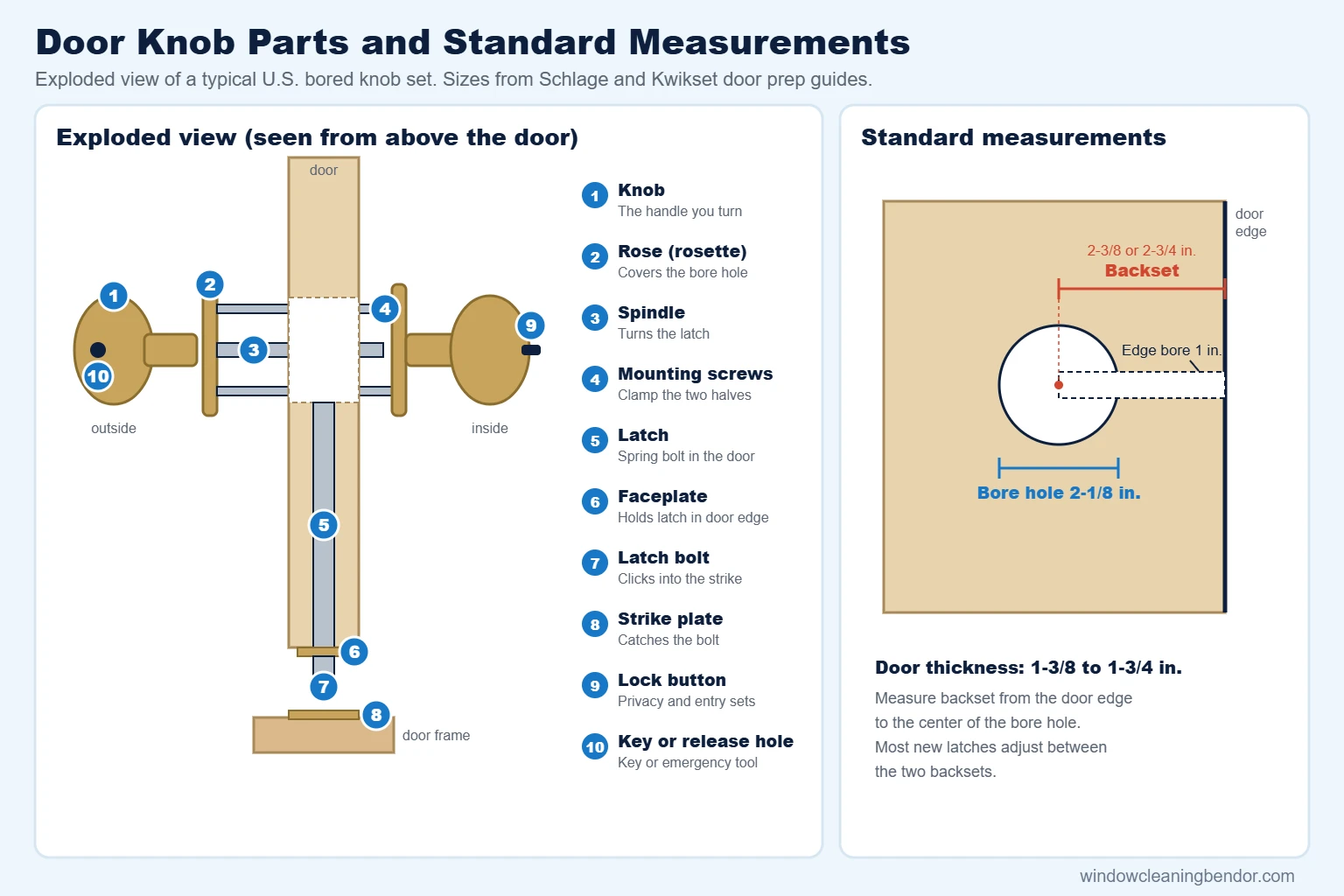
| Part | What it does | Where it is |
|---|---|---|
| Knob | The handle you turn | Both sides of the door |
| Rose (rosette) | Covers the hole and anchors the knob | Flat plate behind each knob |
| Spindle | Carries the turn from the knob to the latch | Runs through the latch, between the knobs |
| Mounting screws | Hold the two halves together through the door | Inside knob side; some are hidden under a cover |
| Latch | Spring-loaded bolt that holds the door shut | Inside the door edge |
| Faceplate | Holds the latch in the door edge | Flat plate on the door edge |
| Strike plate | Catches the latch bolt | On the door frame |
| Lock button or thumb turn | Locks a privacy or entry knob | Center of the inside knob |
| Keyed cylinder | Lets a key lock or unlock the knob | Outside knob on entry sets |
What is the part of a door knob that goes into the frame called?
The latch bolt. It’s the angled metal tongue that sticks out of the door edge and clicks into the strike plate on the frame. The angled side faces the direction the door closes, so the latch slides in without turning the knob. If the latch doesn’t catch, the strike plate is usually out of line.
Door Knob Measurements
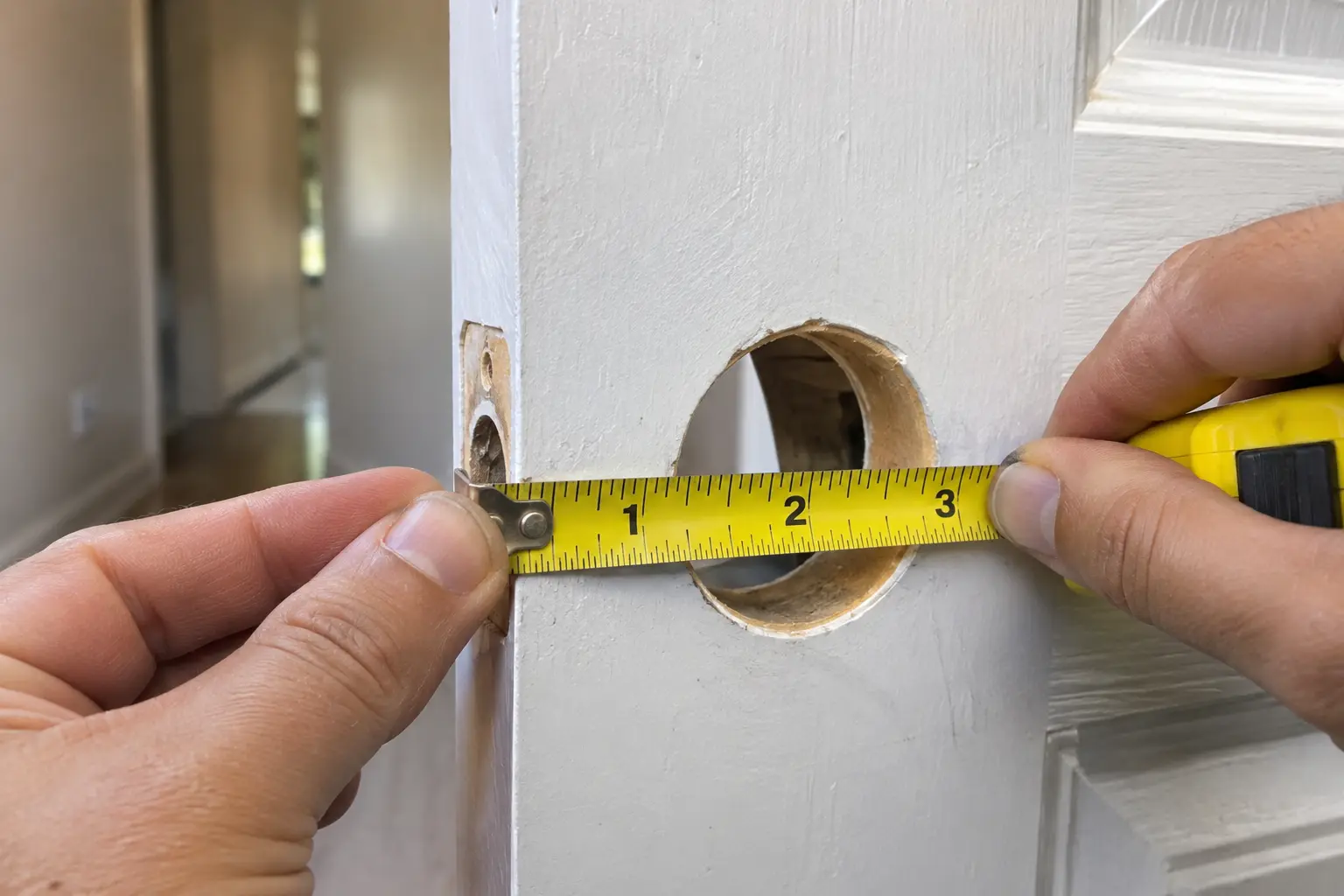
Every replacement knob has to fit the holes already in your door. Schlage lists these standard sizes for its residential knobs and levers (Schlage door prep guide):
| Measurement | Standard size |
|---|---|
| Door thickness | 1-3/8 to 1-3/4 inches |
| Backset | 2-3/8 or 2-3/4 inches |
| Bore hole (door face) | 2-1/8 inches |
| Edge bore (door edge) | 1 inch |
Kwikset’s knob instructions list the same sizes and note that thicker 2-1/4-inch doors need a special kit. Most new latches adjust between the two backsets, so you can switch them without buying a new latch.
How do you measure the backset on a door?
Schlage defines backset as the distance from the edge of the door to the center of the big round hole (Schlage: what is the backset). Measure from the door edge straight across to the middle of the bore hole. You’ll get either about 2-3/8 inches, the more common size on interior doors, or about 2-3/4 inches, which is often used on exterior doors.
Door Knob Functions
Knob sets look alike but work differently inside:
- Passage: No lock. Used for hallways and closets.
- Privacy: Locks with a push button or thumb turn on the inside. Used for bathrooms and bedrooms.
- Keyed entry: Locks with a key on the outside and a button or thumb turn inside. Used for exterior and garage doors.
- Dummy: A fixed knob with no latch. Used on closet doors with a roller catch or on the inactive side of double doors.
How do you unlock a privacy door knob from the outside?
Privacy knobs have a small hole or slot in the center of the outside knob. Push or turn the emergency release tool that came with the set into that hole, and the lock pops open. A small flathead screwdriver or a straightened paper clip often works if the tool is lost. Kwikset tells owners to save the emergency tool for this reason.
Security warning: A spring latch keeps a door closed, but it doesn’t make it secure. The angled latch can be pried or slipped. On exterior doors, use a keyed knob with a separate deadbolt, and don’t count on a passage or privacy knob to keep anyone out.
Older Doors: Mortise Locks and Spindle Knobs
Many older homes, especially those built before World War II, have mortise locks: a rectangular lock box set into a pocket in the door edge instead of a round bore hole. On these doors, a separate square spindle passes through the lock box, and each knob slides onto it and is held with a small set screw on the knob’s neck. The rose is usually screwed to the door face.
Spindle sizes and thread styles varied by maker and era, so bring the old spindle or knob to the hardware store when you shop. Antique hardware sellers stock replacement spindles, set screws, and washers for these sets.
Which Part to Replace for Common Problems
- Wobbly or loose knob: Tighten the mounting screws, or the set screw on older knobs. Our guide on how to fix a loose doorknob shows how to find hidden screws.
- Door won’t stay shut: The latch isn’t reaching the strike. Kwikset suggests bending the strike plate’s tab slightly so it grips the latch, or move the strike plate to line up.
- Knob turns but the door won’t open: The spindle or latch has likely broken inside. Replace the latch, which is often sold separately.
- Knob is stiff: Clean the latch and apply a lubricant made for locks, following the maker’s care guide.
- Squeaking door: This usually comes from the hinges, not the knob. See our guide on how to fix a squeaky door.
Can you replace just one part of a door knob?
Often, yes. Latches, strike plates, and keyed cylinders are sold on their own, and lock retailers list them as separate parts. The knobs themselves usually come as a matched pair. If your door has a nonstandard backset or an old mortise lock, take the old part with you to match it.
Hardware Grades and Knobs vs. Levers
Door hardware is rated by BHMA, the Builders Hardware Manufacturers Association. For bored locks like most knob sets, Allegion, the maker of Schlage, lists the cycle tests: Grade 1 passes 1,000,000 cycles, Grade 2 passes 400,000, and Grade 3 passes 200,000 (Allegion on BHMA grades). Most home knob sets are Grade 2 or 3. Grade 1 is built for heavy commercial use.
Knobs also don’t meet ADA rules for public buildings. The U.S. Access Board says round door knobs don’t comply because turning them takes a tight grip and twisting of the wrist, while lever handles are acceptable (U.S. Access Board guide to operable parts). The rule doesn’t apply to most private homes, but levers are easier for kids, older adults, and anyone with full hands.
Door Knobs: Pros and Cons
| Pros | Cons |
|---|---|
| Less likely to catch clothing or bags | Harder to turn with wet hands or arthritis |
| Harder for pets to open by jumping | Not ADA compliant for public buildings |
| Classic look for older homes | Small kids can’t always grip them |
| Wide choice of affordable sets | Old mortise knobs can be hard to match |
Related Door Fixes
Before you shop, check your door’s size with our guide to standard door sizes, since door thickness affects which knob fits. A new knob won’t stop drafts around an exterior door, so see our guide to door weather stripping as well. In Central Oregon, our commercial window cleaning service keeps glass storefront and office doors clear of fingerprints and dust.
The Bottom Line
A door knob is a set of simple parts: two knobs, roses, a spindle, screws, a latch, and a strike plate. Most U.S. doors use a 2-1/8-inch bore hole with a 2-3/8 or 2-3/4-inch backset on a door 1-3/8 to 1-3/4 inches thick, so measure before you buy. Pick the function for the room, replace only the part that failed when you can, and add a deadbolt on exterior doors.


One Comment
Comments are closed.