
A heat pump replaces your central air conditioner and can replace your furnace too, because it moves heat out of the house in summer and pulls heat in from outside air in winter. A typical ducted swap-out takes a licensed HVAC crew one day, about 4 to 8 hours, once the system is chosen. The job includes a load calculation to size the system, removing the old equipment, setting the outdoor unit, connecting the indoor unit, refrigerant lines, and wiring, then testing heating, cooling, and defrost. Rewiring America puts a whole-home system for a 1,500- to 2,500-square-foot house at about $17,000 to $23,000, and a single-room ductless unit at about $5,400 to $8,500.
Most guides to this come from equipment makers or local HVAC companies that end with “call us.” This guide walks through the whole process in plain terms, gives real cost figures, and answers the questions a new homeowner asked on Reddit after two HVAC contractors brushed them off.
How a Heat Pump System Works
A heat pump is an air conditioner that can run in reverse. In summer it pulls heat out of your home, and in winter it moves heat from the outdoor air inside. The U.S. Department of Energy says modern air-source heat pumps can cut electricity use for heating by up to 75% compared with electric resistance heat like baseboards or an electric furnace (DOE Energy Saver on heat pump systems).
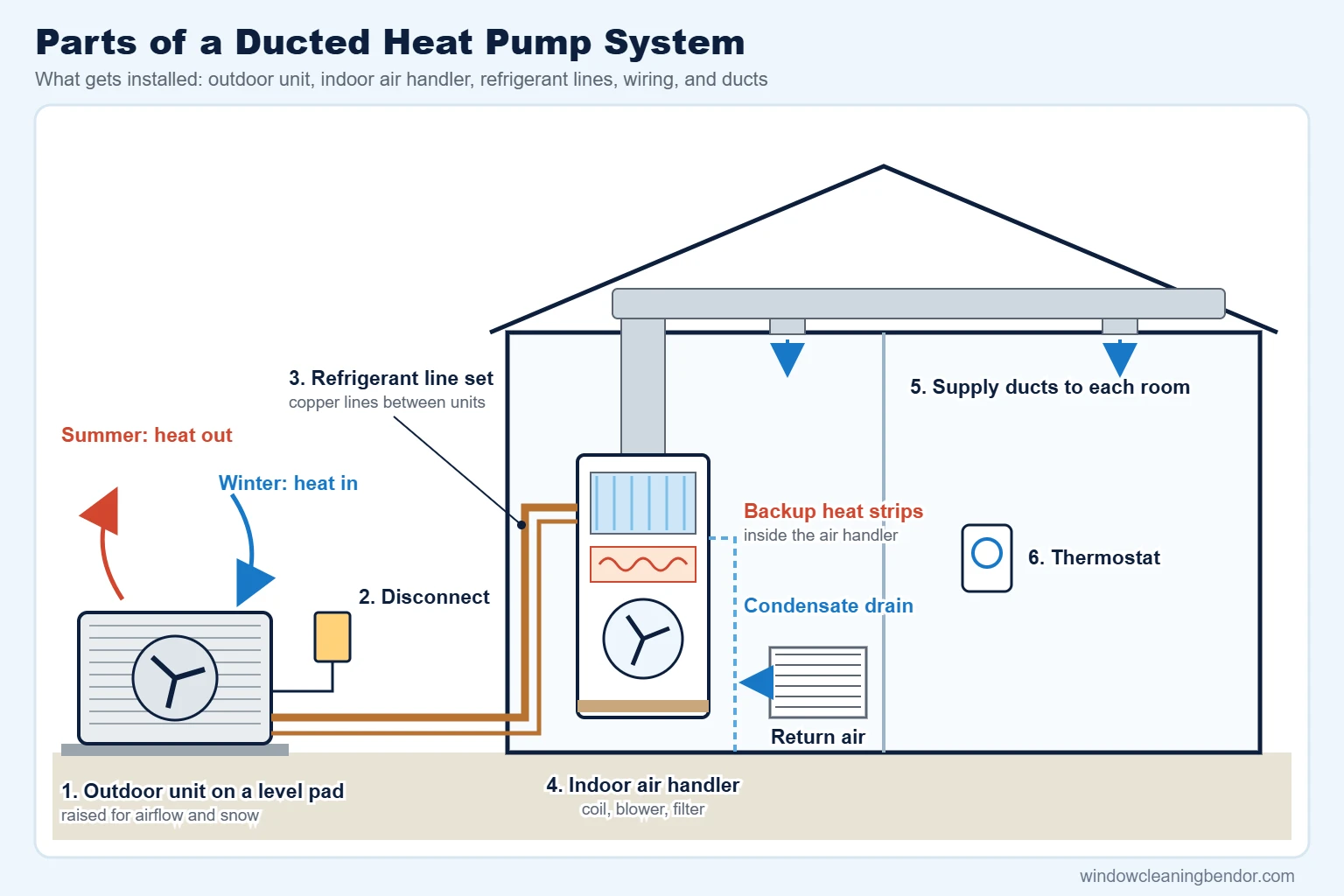
The diagram below shows the main parts of a typical ducted system.
Does a heat pump replace both the AC and the furnace?
It always replaces the air conditioner. Whether it also replaces the furnace is your choice. An all-electric system uses the heat pump for heating, with electric heat strips in the indoor unit as backup on the coldest days. A dual-fuel (hybrid) system keeps a gas furnace and switches to it when it gets very cold. In mild-winter areas, many homeowners skip the furnace entirely. On the Reddit thread, commenters said a Memphis home could likely do without one, and several in the Northeast said their heat pumps carry the whole load with no backup.
Do heat pumps work in cold weather?
Yes, much better than older models did. DOE says cold-climate heat pumps are designed to work at temperatures as low as 5°F, and it suggests the ENERGY STAR Cold Climate label in places with regular freezing winters. Several Reddit commenters in New York, New England, and Canada said their units kept up in single-digit and below-zero weather. One commenter added that the house matters as much as the equipment: insulation, air sealing, and ducts inside the heated space let a smaller system keep up.
Ducted vs. Ductless: Which System Fits Your Home?
| System | Best for | Notes |
|---|---|---|
| Ducted (central) heat pump | Homes with existing ductwork | Replaces the AC and furnace or air handler; one thermostat |
| Dual-fuel (heat pump plus gas furnace) | Very cold areas, or keeping an existing furnace | Furnace takes over in deep cold |
| Ductless mini-split, single-zone | One room, an addition, or a garage | Wall-mounted indoor head; no ducts needed |
| Ductless mini-split, multi-zone | Homes without ducts | One outdoor unit feeds several indoor heads |
| Geothermal (ground-source) | New builds or large lots | Highest install cost; DOE says ENERGY STAR models use 61% less energy |
A Reddit commenter with years of experience put it simply: if your house already has ducts, use them. A ducted system heats and cools every room evenly, including bathrooms, without indoor units on the walls. DOE also calls mini-splits the usual choice for homes without ductwork.
The Heat Pump Installation Process, Step by Step
- Load calculation. A good contractor measures your home and runs a Manual J load calculation, the industry method for sizing heating and cooling, instead of just matching your old unit or using square footage alone. An oversized system cycles on and off too often, and an undersized one struggles on the hottest and coldest days.
- System selection and quote. You choose the type, size, efficiency, and backup heat. The contractor usually supplies the equipment as part of the quote.
- Permits. Most areas require a mechanical permit and sometimes an electrical permit. The contractor typically pulls them.
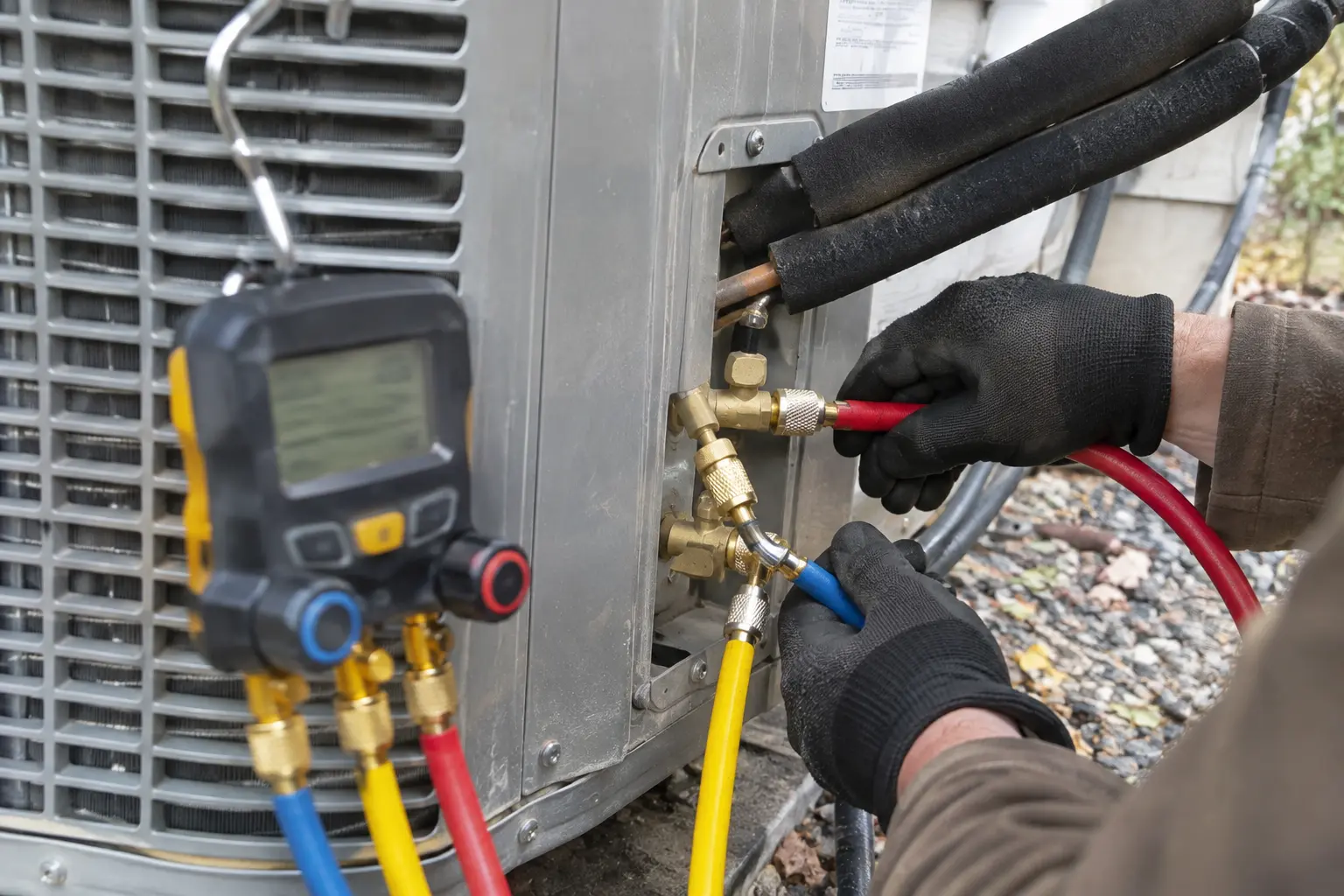
- Removing the old equipment. The crew recovers refrigerant from the old system with a recovery machine, then disconnects and hauls away the old units. Federal rules require refrigerant work to be done by certified technicians.
- Setting the outdoor unit. The unit goes on a level pad, raised above ground and snow, with space around it for airflow.
- Installing the indoor unit. That’s a new air handler or a coil on your existing furnace for ducted systems, or wall-mounted heads for mini-splits.
- Running refrigerant lines and the drain. Copper lines connect the two units. The installer pressure-tests them for leaks and pulls a vacuum before releasing refrigerant.
- Electrical work. Most central heat pumps need a dedicated 240-volt circuit and an outdoor disconnect. Older homes sometimes need a panel upgrade, especially with large electric backup heat strips.
- Commissioning. The crew checks refrigerant charge and airflow, then tests cooling, heating, defrost, and backup heat, and sets up the thermostat.
- Walkthrough. You should learn how to use the thermostat, change the filter, and register the warranty.
Do-it-yourself warning: Installing a heat pump involves high-voltage wiring and pressurized refrigerant, and federal rules require certified technicians to handle refrigerant. Many equipment warranties also require professional installation. Leave the refrigerant and electrical work to a licensed contractor.
Carrier, Trane, and Bryant all say a standard installation takes 4 to 8 hours. Jobs with new ductwork, electrical upgrades, or several mini-split heads can take one to two days.
How Much Does It Cost?
| Project | Typical cost |
|---|---|
| Whole-home system, 1,500 to 2,500 sq ft | About $17,000 to $23,000 (median $19,500) |
| Whole-home system, 2,500 to 5,500 sq ft | About $22,500 to $28,000 (median $25,000) |
| Single-zone ductless mini-split | About $5,400 to $8,500 (median $6,600) |
These are national estimates for equipment and installation from Rewiring America’s heat pump cost guide. The biggest cost drivers are system size, whether your ducts can be reused, electrical upgrades, efficiency level, and local labor rates. For a real-world check, one Kentucky homeowner on Reddit paid $18,500 for two 2-ton ducted inverter units that reused existing ducts.
Incentives have changed in 2026. The federal tax credit for heat pumps is gone. The IRS says the Energy Efficient Home Improvement Credit doesn’t apply to property placed in service after December 31, 2025 (IRS energy credit FAQs). Ask your electric utility and state energy office about rebates, which vary widely by area.
What is a SEER rating, and does a higher one matter?
SEER2 measures cooling efficiency over a season, and HSPF2 measures heating efficiency. Higher is better for both. Since 2023, DOE has required new split-system heat pumps nationwide to have at least 14.3 SEER2 and 7.5 HSPF2 (DOE 2023 standards FAQ). Higher-rated units cost more up front and save more on bills, so the payoff depends on your climate and how much you run the system. One Reddit commenter felt the mid-range was the sweet spot, since the top-rated systems cost much more.
How to Find a Good Installer
Why don’t some HVAC contractors want to install heat pumps?
Some installers learned on older heat pumps that struggled in the cold and still prefer furnaces. Reddit commenters suggested looking for contractors who install heat pumps often, using the dealer search on manufacturers’ websites, and pushing back on the “heat pumps don’t work below freezing” line.
When you collect bids, ask each contractor:
- Will you do a Manual J load calculation?
- Is the equipment, permit, and removal of the old system included?
- Does my electrical panel need an upgrade?
- What backup heat do you recommend, and at what temperature does it turn on?
- What are the parts and labor warranties?
Get at least three written quotes for the same type of system so you can compare them fairly.
New systems now use lower-impact refrigerants such as R-454B and R-32. In 2026, EPA updated its rules so contractors can still install remaining R-410A systems made before 2025. Ask which refrigerant your quote includes, since it affects future service costs.
Heat Pump vs. AC and Furnace: Pros and Cons of a Heat Pump
| Pros | Cons |
|---|---|
| One system heats and cools | Higher upfront cost than an AC alone |
| Uses far less electricity than electric resistance heat | May need backup heat or a furnace in very cold areas |
| Removes combustion from heating if you go all-electric | Can require electrical panel upgrades |
| Variable-speed models run quietly and evenly | Quality depends heavily on the installer |
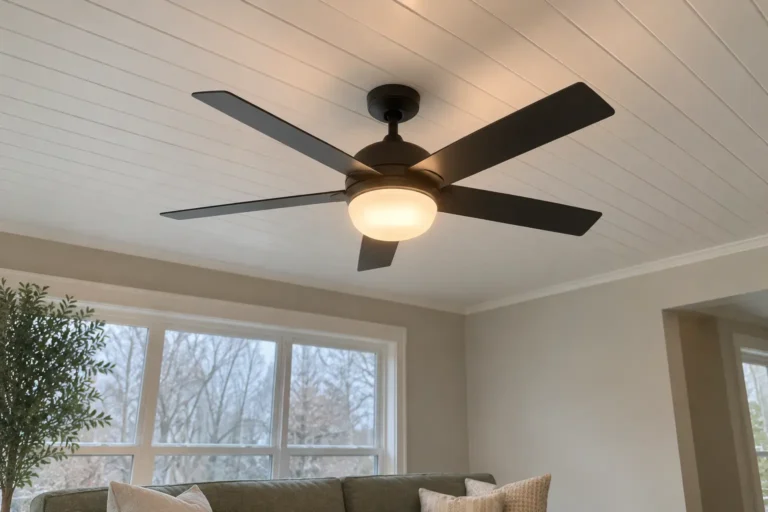
DOE suggests weatherizing older homes before switching from gas. Sealing drafts with door weather stripping and following our guide on how to reseal windows can let a smaller system do the job. Our guide to low-E glass explains how better windows cut heat gain, and a ceiling fan helps spread the air, as covered in our guide on how to install a ceiling fan. In Central Oregon, if you pair a heat pump with rooftop solar, our solar panel cleaning service helps keep the panels free of dust and pollen.
The Bottom Line
A heat pump replaces your AC and can replace your furnace, and a typical ducted installation takes a day once the system is chosen. Insist on a Manual J load calculation, get at least three quotes, and expect about $17,000 to $23,000 for a whole-home system in an average-size house, or $5,400 to $8,500 for one ductless zone. The federal tax credit ended after 2025, so check your utility and state for rebates, and leave the refrigerant and electrical work to a licensed pro.


One Comment
Comments are closed.