
To use a slow cooker, start with thawed meat cut into chunks and put firm vegetables like potatoes and carrots on the bottom. Add the meat, seasonings, and enough liquid to keep everything moist, filling the pot between half and two-thirds full. Put the lid on, choose Low or High, and leave it alone until the cooking time is up, usually several hours on Low or about half as long on High. Check that meat reaches a safe internal temperature, then refrigerate leftovers within 2 hours. That’s really all there is to it, with a few habits that make the food taste better and keep it safe.
A slow cooker is one of the easiest ways to make home-cooked meals if you don’t love cooking. You can prep in the morning, walk away for the day, and come home to dinner. This guide covers the basic steps, how Low and High compare, the food safety rules most recipe sites skip, and answers to the questions new cooks actually ask.
Slow Cooker Basics
A slow cooker, also called a Crock-Pot (the best-known brand), heats food in a ceramic or metal pot surrounded by a heating element. Clemson University’s Home and Garden Information Center says slow cookers run at about 170°F to 280°F, which is hot enough to cook food safely as long as you follow a few rules (Clemson HGIC on slow cooker safety).
Most models have three settings:
- Low: For all-day cooking. Crock-Pot says Low runs about 164°F to 182°F.
- High: About twice as fast as Low. Crock-Pot lists High at about 205°F.
- Warm: For holding food that’s already cooked. Crock-Pot says not to keep food on Warm for more than 4 hours.
A 3- to 4-quart cooker suits one or two people. Pick a larger one for a family or if you want leftovers.
Using a Slow Cooker, Step by Step
The diagram below shows how to load the pot.

1. Prep and thaw your food
Thaw meat and poultry in the fridge first. Michigan State University Extension says frozen meat may not warm fast enough to stop germs from growing, though frozen vegetables can go in straight from the freezer (MSU Extension on cooking safely with a slow cooker). Cut meat into chunks rather than using a huge roast or whole bird, so it heats evenly.
Can you put frozen meat in a slow cooker?
Food safety experts say no. Clemson and MSU Extension both say to thaw meat and poultry completely first, because frozen meat sits too long in the temperature range where bacteria grow. Some brand guides allow frozen meat if you check it with a thermometer, but the safer habit is to thaw it in the fridge overnight.
2. Brown the meat if you have time
Searing meat in a hot pan for a few minutes before it goes in the slow cooker adds deep, savory flavor and color. It isn’t required for safety, but it makes a big difference in stews, chili, and pot roast. Some newer models have a browning setting so you can sear right in the pot.
Can I just throw everything in and leave it?
Mostly, yes. That’s the whole appeal. As one Reddit commenter put it, you still need to prep and season the food, and sometimes sear the meat, or the result can taste bland. But once everything is in the pot with the lid on, you can walk away.
3. Layer the pot
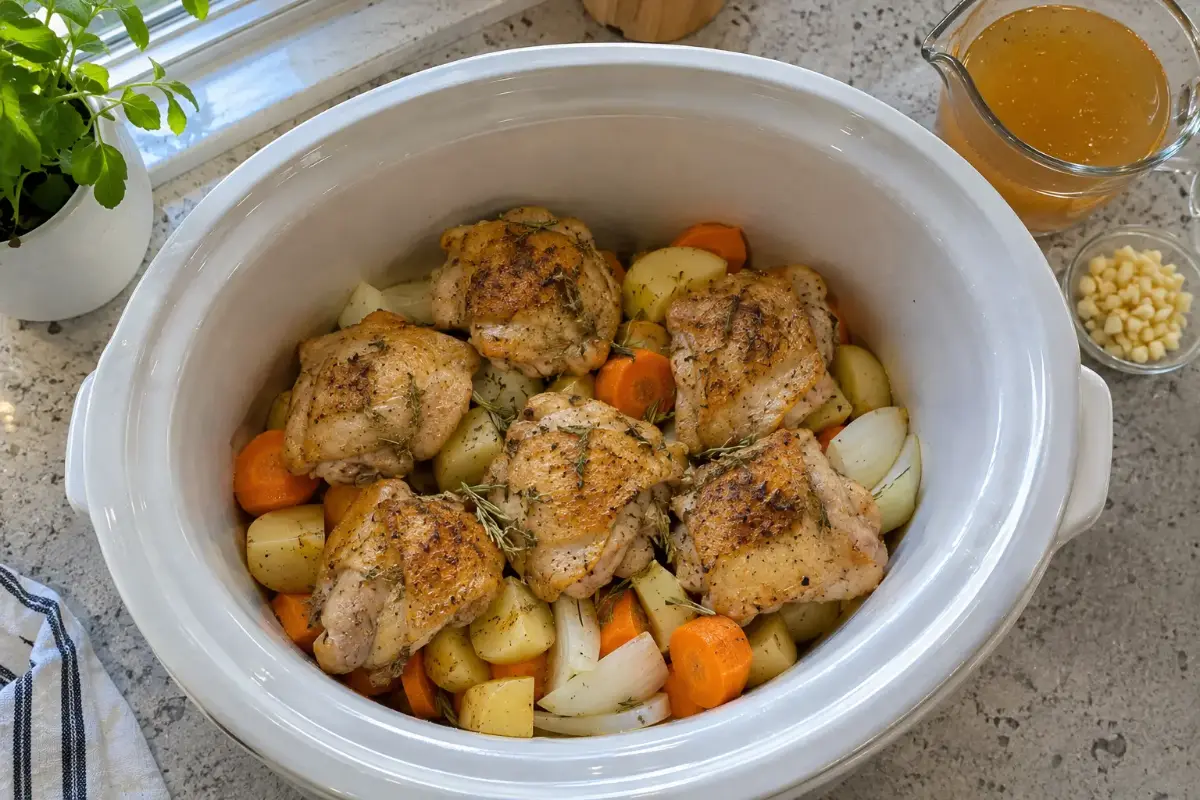
Put firm vegetables like potatoes, carrots, and onions on the bottom and around the sides, since Clemson notes they cook more slowly than meat. Add the meat on top, then the seasonings and liquid.
4. Add liquid and fill to the right level
Fill the pot at least half full and no more than two-thirds full, as both Clemson and MSU recommend. Too little food can overcook or scorch, and too much may not heat through safely. Slow cookers trap steam, so you need less liquid than on the stove. Recipes made for slow cookers already account for this.
How full should a slow cooker be?
Between half and two-thirds full, according to Clemson and MSU Extension. Some home cooks on Reddit fill theirs closer to three-quarters, but going over two-thirds can keep the food in the middle from heating up quickly enough. If a recipe is too big for your pot, cut it down rather than packing it to the brim.
5. Put the lid on and leave it
Keep the lid on. MSU Extension says the temperature can drop 10 to 15 degrees every time you lift it, which slows cooking. Only open it to stir or check doneness near the end.
6. Choose the setting and time
Clemson suggests starting on High for the first hour if you can, then switching to Low or the recipe’s setting. Cooking on Low the whole time is also safe, such as when you’re gone all day.
7. Check doneness and finish
Use a food thermometer to check meat, then stir in any dairy or quick-cooking ingredients near the end. Crock-Pot says to add milk, yogurt, or sour cream during the last 15 minutes so it doesn’t curdle.
Low vs. High: Cooking Times
Low takes about twice as long as High. These times come from Crock-Pot’s cooking guide.
| Food | Low | High |
|---|---|---|
| Boneless chicken breasts | 2 to 3 hours | 1 to 2 hours |
| Chuck roast | 9 to 10 hours | About 7 hours |
| Salmon | About 1 hour | About 30 minutes |
| Whole chicken | 7 to 8 hours | Check the recipe |
Every cooker heats a bit differently, so check with a thermometer the first few times you cook something new.
Safe internal temperatures
| Food | Safe temperature |
|---|---|
| Beef and pork roasts, steaks, chops | 145°F |
| Ground meat | 160°F |
| Poultry | 165°F |
| Soups, stews, and sauces | 165°F |
These temperatures come from Clemson’s slow cooker guide. A good instant-read thermometer makes this easy, and our guide to the best wireless meat thermometer compares a few options.
Slow Cooker Food Safety Rules
Kidney bean warning: Don’t cook dry red kidney beans from raw in a slow cooker. Kansas State University says a slow cooker likely won’t get hot enough to destroy a natural toxin in the beans, and eating as few as four or five undercooked beans can cause severe vomiting. The FDA recommends soaking the beans and boiling them in fresh water for at least 30 minutes first (K-State on cooking dry beans safely). Canned beans are already cooked and are fine to add.
A few more rules from Clemson and MSU Extension:
- Don’t reheat leftovers in the slow cooker. Reheat them on the stove or in the microwave to 165°F first.
- Refrigerate leftovers within 2 hours in shallow, covered containers.
- If the power goes out while you’re away, throw the food out, even if it looks done.
- Test an older cooker. Fill it half to two-thirds with water, heat it on Low for 8 hours, and check the water. It should read about 185°F. MSU says a cooker that falls short may not heat food safely.
Is it safe to use a plug-in timer to start the slow cooker later?
Not with raw meat or other perishable food. A Reddit tip suggested plugging the cooker into a lamp timer so it turns on later, but the food would sit at room temperature until it starts. Clemson and MSU say food should stay out of the 40°F to 140°F danger zone, and leftovers shouldn’t sit out more than 2 hours. A programmable cooker that switches to Warm when it’s done is a safer choice.
Is it safe to leave a slow cooker on while you’re at work?
Yes. Clemson says cooking on Low the whole time is safe when you’re away all day. Set it on a flat, heat-safe counter away from the wall and anything that can burn, and keep the cord where it can’t be pulled.
Slow Cooker vs. Pressure Cooker: Pros and Cons of a Slow Cooker
| Pros | Cons |
|---|---|
| Very little hands-on time | Takes hours, so you have to plan ahead |
| Turns cheap, tough cuts tender | Can make lean meat and pasta mushy |
| Easy for beginners, with few settings | Food can taste flat without browning or seasoning |
| Safe to leave on Low all day | Not safe for raw kidney beans or frozen meat |
Cleaning and Care
Let the ceramic insert cool before you wash it. Sudden temperature changes, like cold water on a hot pot, can crack it. Soak stuck-on food in warm, soapy water, and check the manual to see whether the insert and lid are dishwasher safe. Hard water can leave a white film on the insert and glass lid. Our guide to water softener costs explains what causes it. If you host a vacation rental in Central Oregon, a slow cooker is an easy appliance for guests, and our vacation rental window cleaning service keeps the rest of the place ready between stays.
The Bottom Line
A slow cooker takes almost no skill: thaw your meat, layer firm vegetables on the bottom, fill the pot half to two-thirds full, put on the lid, and cook on Low or High until it reaches a safe temperature. Brown meat and season well for better flavor, add dairy at the end, never cook raw kidney beans in it, and refrigerate leftovers within 2 hours.
One Comment
Comments are closed.