
Most homes pay about $1,000 to $4,000 for a water softener that’s installed and running. A basic salt-based unit costs about $400 to $1,500, and a plumber usually charges about $200 to $600 to install it, more if new plumbing or a drain line is needed. Larger dual-tank systems and salt-free conditioners cost more, often $1,500 to $3,500 for the unit alone. After that, plan on salt at about $5 to $10 per 40-pound bag. An in-home quote of $9,000 to $15,000 for a standard home usually includes extras, financing, or sales costs, not better softening.
Water softener system cost guides from brands and dealers often contradict themselves or leave out what you’ll spend each year. This guide gathers the price ranges, shows what affects them, explains how to size a softener so you don’t overpay, and lists what to ask before you sign.
Average Water Softener Prices at a Glance
| Cost item | Typical range |
|---|---|
| Salt-based softener, unit only | $400 to $1,500 |
| Dual-tank softener, unit only | $1,500 to $3,500 |
| Salt-free conditioner, unit only | $1,000 to $3,000 |
| Magnetic or electronic descaler | $100 to $500 |
| Professional installation | $200 to $600, more for new plumbing |
| Salt, per 40-pound bag | $5 to $10 |
| Potassium chloride, per 40-pound bag | Up to $25 |
Unit and labor ranges come from cost guides by Best Company and Aquasana. Salt prices come from North Dakota State University Extension (NDSU on water softening). Homewyse, which tracks contractor pricing, put a basic installed softener at $1,131 to $1,405 in May 2026, before permits and tax.
Real buyers report similar numbers. In one Reddit thread on softener prices, most homeowners who paid a licensed plumber said they spent about $1,200 to $4,000 for the unit and labor, with $2,000 the most common figure.
What Affects the Price
- Type of system: A single-tank salt softener is the cheapest. Dual-tank units cost more but give soft water around the clock, even during regeneration.
- Size (grain capacity): Bigger units cost more. Home units commonly range from about 24,000 to 64,000 grains.
- Control valve: A demand-based valve that regenerates only when needed costs more up front but uses less salt and water than a simple timer.
- Installation: Price jumps if there’s no existing softener loop, the drain or outlet is far away, or the plumber has to reroute pipes.
- Extras: Iron filters, carbon filters, and reverse osmosis drinking water systems are often bundled into dealer quotes.
- Permits: Some cities require a plumbing permit.
How a Water Softener Works
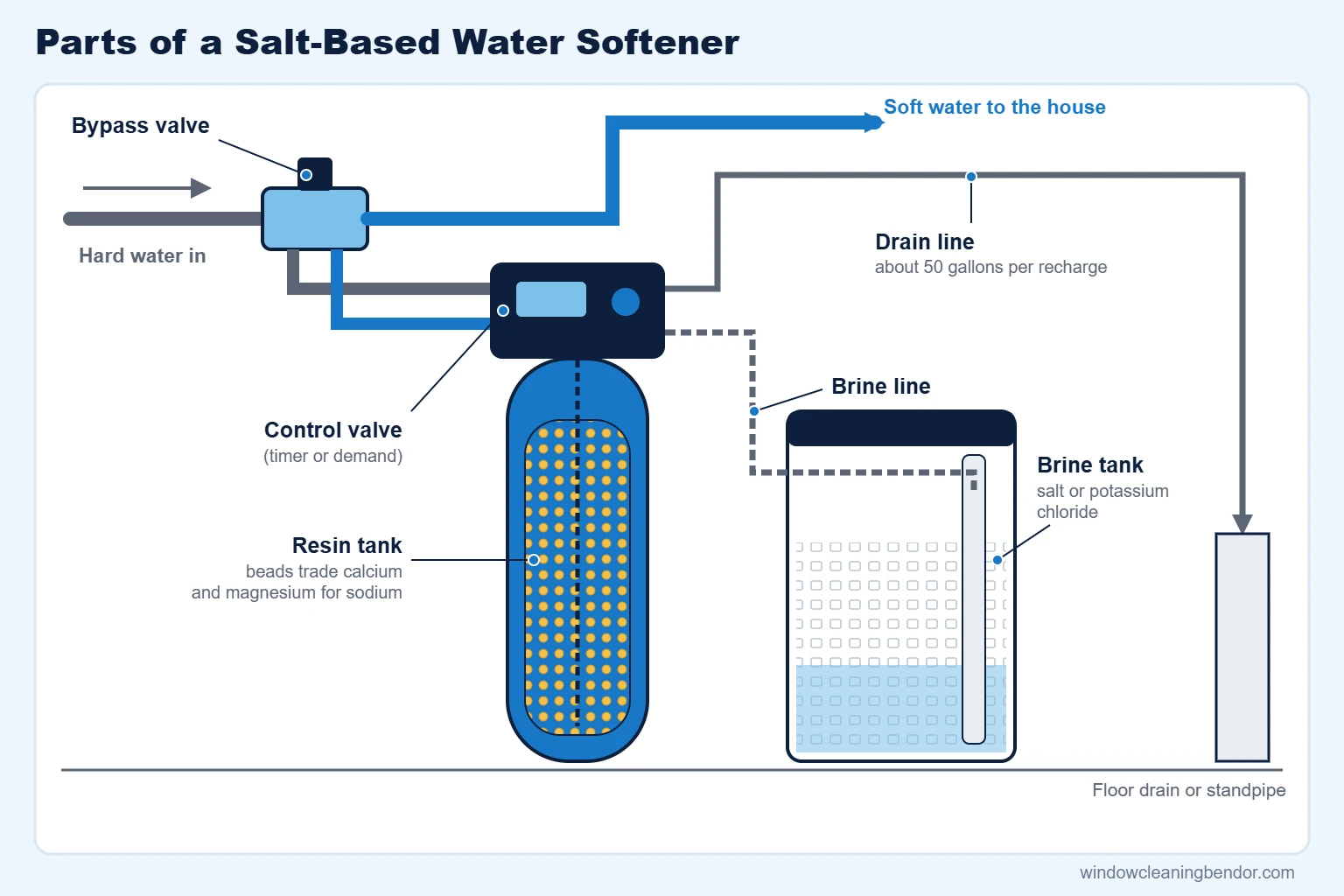
A salt-based softener pushes hard water through a tank of resin beads. Penn State Extension explains that the resin trades sodium for the calcium and magnesium that cause hardness. When the resin is full, the softener flushes it with salt brine to recharge it, which is called regeneration (Penn State Extension on water softening). The diagram below shows the main parts.
Do You Need a Softener?
Test your water first. The U.S. Geological Survey rates water by its calcium and magnesium content (USGS on water hardness):
| Hardness (mg/L) | Grains per gallon | USGS rating |
|---|---|---|
| 0 to 60 | 0 to 3.5 | Soft |
| 61 to 120 | 3.6 to 7 | Moderately hard |
| 121 to 180 | 7.1 to 10.5 | Hard |
| Over 180 | Over 10.5 | Very hard |
One grain per gallon equals about 17 mg/L. Penn State says water below 7 grains per gallon probably won’t cause major scaling and soap film, and that softening is a matter of preference, not a must. Many city water utilities post hardness in their yearly water quality report, or you can buy a test kit or use a lab.
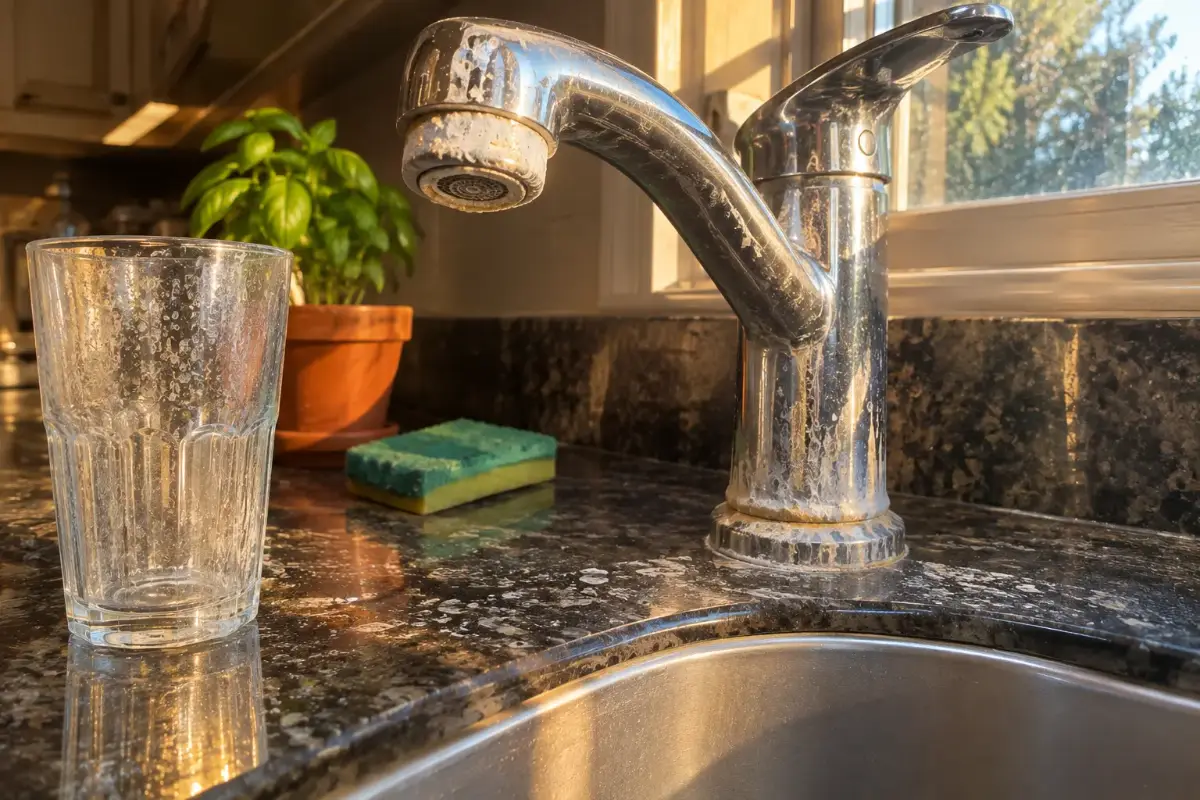
Signs your water is hard include white crust on faucets and shower heads, spots on dishes and glass, and soap that won’t lather. Our guide on the best way to clean windows explains how those mineral spots form on glass. Scale also wears out shower valves, as our guide on how to replace a shower cartridge shows.
How to Size a Softener So You Don’t Overpay
An oversized softener costs more and can waste salt, while an undersized one regenerates too often. Here’s a simple way to size one, based on Penn State’s example:
- Find your hardness in grains per gallon.
- Multiply by daily water use. Penn State’s example uses about 75 gallons per person per day.
- Multiply by 7 so the softener regenerates about once a week.
For example, a family of four with 10 grains per gallon uses about 3,000 grains a day (4 × 75 × 10). Over a week, that’s about 21,000 grains, so a 24,000- to 32,000-grain softener fits. If your water has iron, add capacity or a separate iron filter, since iron clogs the resin. A good installer will do this math with you and show it in writing before quoting a size.
Yearly Running Costs
- Salt: Best Company estimates $60 to $100 a year for most homes. Harder water and bigger families use more.
- Potassium chloride: Some people use it in place of salt to avoid adding sodium. NDSU notes it costs more and you’ll use about 10% more of it.
- Water: Penn State says each regeneration uses about 50 gallons of water. That matters if you’re on a septic system.
- Upkeep: Clean the brine tank now and then, and check the brine valve and float. Some resins eventually need replacement.
Over 10 years, a $1,500 installed softener plus about $80 a year in salt comes to roughly $2,300. Compare that to the cost of scale damage to water heaters, faucets, and appliances before you decide.
Sodium note: Softening adds sodium to your water. Penn State says it adds 7.5 mg per quart for each grain per gallon of hardness removed, so very hard water ends up with more sodium. If you’re on a low-sodium diet, ask your doctor, and consider leaving one kitchen tap unsoftened or adding a reverse osmosis filter for drinking water.
DIY vs. Professional Installation: Pros and Cons of DIY
| Pros | Cons |
|---|---|
| Saves about $200 to $600 in labor | Mistakes can cause leaks or water damage |
| Online units cost less than dealer systems | Some cities require a licensed plumber and a permit |
| Easy if a softener loop is already in place | Cutting into copper or adding a drain line takes skill |
| You choose the brand and size | Warranty may require professional installation |
Red Flags in a Softener Quote
High-pressure in-home sales are common in water treatment. In the same Reddit thread, a homeowner got a $10,000 to $15,000 quote after an in-home demo, and others said a fair installed price was a fraction of that. Watch for:
- A price that’s only given after a long demo, with a “today only” discount.
- Bundles you didn’t ask for, like whole-house filtration or “alkaline” water.
- Financing rolled into the price without a clear total.
- Proprietary parts that only the dealer can service.
- No water test results on paper.
Ask for the brand, valve model, grain capacity, and warranty in writing, and get two or three quotes, including one from a local plumber.
Salt-Free Systems and Local Rules
Salt-free “conditioners” don’t remove calcium and magnesium the way a salt-based softener does, so you won’t get the slick feel of softened water. They’re aimed at reducing scale instead. Ask for independent test results before you pay a premium for one.
Some places limit salt-based softeners because brine adds salt to wastewater. In California, state law lets certain local sewer agencies require permits, ban new self-regenerating softeners, or require efficient models (California Water Code 13148). Check with your city before you buy.
If your water comes from rain instead of a well or city line, it’s naturally soft. Our guide on what a cistern is explains how rainwater storage works. Hard water can also crust over bidet nozzles, which our guide on how to use a bidet covers. In Central Oregon, see our page on whether Bend has hard water, and our hard water stain removal service clears mineral spots from windows and shower glass.
Frequently Asked Questions
How much does it cost to install a water softener?
Labor usually runs about $200 to $600 if a softener loop is already in place. New plumbing, a long drain line, or a new outlet can raise the cost. Most installed jobs land between about $1,000 and $4,000.
Is a $10,000 water softener worth it?
Rarely for a standard home. Most of that price is extras, financing, and sales costs. Ask what’s included and compare the same grain capacity and valve from a local plumber.
How long does a water softener last?
Many makers quote 10 to 20 years for the unit. Resin and valves can wear out sooner with very hard water, iron, or chlorine.
How much salt does a water softener use?
It depends on your hardness, water use, and valve type. Best Company puts the yearly cost at about $60 to $100, which is roughly 6 to 20 bags.
The Bottom Line
A typical installed water softener costs about $1,000 to $4,000, with salt adding about $60 to $100 a year. Test your water first, size the softener to your hardness and household, and get written quotes that name the brand, capacity, and valve. If a quote climbs toward five figures, it’s usually extras and sales costs, not better soft water.


2 Comments
Comments are closed.